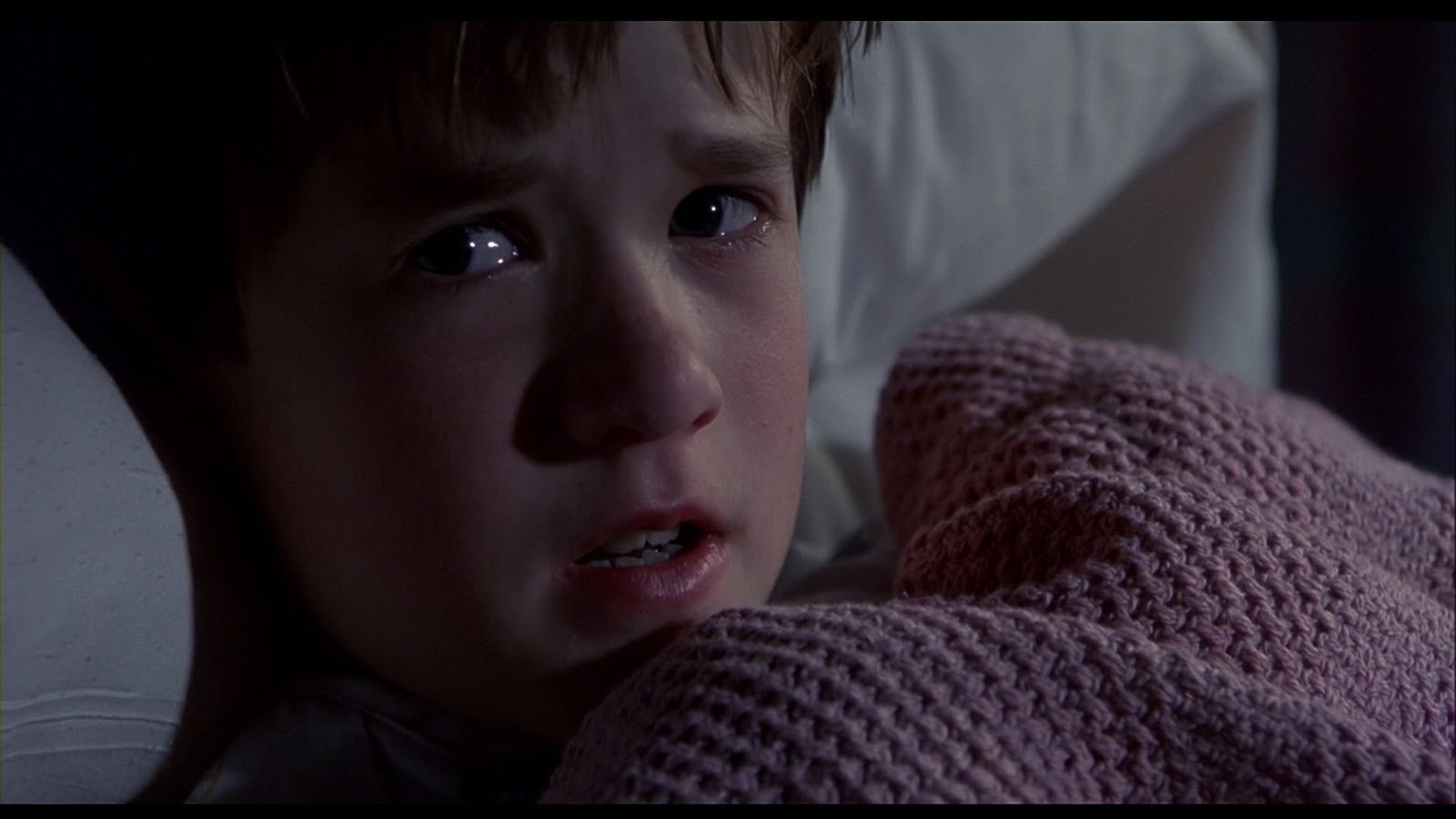
eerie
1: chiefly Scottish : affected with fright : scared
2: so mysterious, strange, or unexpected as to send a chill up the spine "a coyote's eeriehowl" "the similarities were eerie"; also : seemingly not of earthly origin "the flames cast an eerie glow"
1: chiefly Scottish : affected with fright : scared
2: so mysterious, strange, or unexpected as to send a chill up the spine "a coyote's eeriehowl" "the similarities were eerie"; also : seemingly not of earthly origin "the flames cast an eerie glow"
 Within the first few seconds of The Sixth Sense, a naked light bulb gradually heats up within a dark setting . This prop, sparking to life, gives out a hint with a symbolic idea of the presence of ghosts . The light within the opening credits maintains an eerie and surreal atmosphere which builds up the suspense.

In the movie 'Twelve Monkeys' (1995), Bruce Willis's character, James Cole says 'all I see is dead people', which echoes the words said by Haley Joel Osment's character Cole Sears' the now popcultural reference and masterpiece quote - 'I see dead people' in the Sixth Sense (1999).

SPOILER ALERT
IF YOU HAVEN´T SEEN THE SIXTH SENSE
PLEASE GO WATCH IT
AND COME BACK


Just hearing the first notes of James Newton Howards soundtrack brings back the fall of 1999. This is a time before the boom of social media and 9-11. Many were longing the raw cinema of the 70s or the fun of the 80´s. If a movie came in the late 90´s to scare us all it was The Sixth Sense. Not a laughable ghost story, but a true testament of human creative intelligence. As many movies before having famous TRAILERS, if some one told you it was good you had to see it. You payed your ticket not knowing what you were going see.

The first time i saw The Sixth Sense it was the first showing of a saturday, at 11 am. When i came out i was really scared. I understood why cinema is an immersive experience. The darkness, the sound, the whole atmosphere caught my whole attention. It was a movie you had to see in theatres. The best part of it, is not the surprise ending , but how intelligent the narrative was. You have to see this film.

 Bruce Willis plays Malcolm Crowe a child psychologist who suffers an assault and witness the suicide of one of his ex-patients, he is left determined to help a young isolated boy named Cole Sear (Haley Joel Osment), hiding a secret that makes him terrified. With Dr. Crowe's help Cole goes on a journey to overcome his fears, while trying to discover the true purpose of his Supernatural gift .
The Sixth Sense is written and directed by M. Night Shyamalan this film introduced the cinema public to his traits, most notably his affinity for surprise endings.

The sixth sense is another term for extrasensory perception. Extrasensory perception (ESP) would involve the reception of information not gained through the recognized senses and not internally originated.
The traditional five senses of sight, hearing, touch, smell, and taste, a classification attributed to Aristotle.

"think of it as an invisible animal in the room, that you hear crawling and moving around you and you are not sure where it is, but you feel threatened by it, and its going to attack you, you don´t know where it is and just when you feel you are going to be attacked, it leaves the room"
-M. Night Shyamalan
"He would talk about the sixth sense as .....a living entity that is sort of morphing from room to room in the house , appearing in a very liquid way "

-James Newton Howard (composer)

Have you ever left this movie playing ?
And listen to it from another room.
Have you ever been alone in your house when it starts to rain? Everything changes, from color to grey in a matter of seconds, the atmosphere, the climate, everything becomes eerie. The Sixth Sense does that with our minds.

Released by Hollywood Pictures on August 6, 1999, the film was received well; critics highlighted the performances (especially by Osment, Collette and Willis), its atmosphere, and twist conclusion. The film was the second highest grossing film of 1999 (behind Star Wars: Episode I – The Phantom Menace), grossing about $293 million domestically and $672 million worldwide. The film was nominated for six Academy Awards, including Best Picture, Best Director for Shyamalan, Best Original Screenplay, Best Supporting Actor for Osment, and Best Supporting Actress for Toni Collette

THE DISNEY EXECUTIVE WHO BOUGHT THE SCRIPT WAS FIRED BECAUSE OF IT.

Walt Disney Studios' then-president David Vogel, didn’t bother to consult with his superiors before paying $2.25 million for the rights to The Sixth Sense, and agreed to let Shyamalan direct the already-expensive film. Vogel’s boss was livid when he found out about the deal, and demanded that Vogel relinquish some of his power. When Vogel refused, he was fired.

 IT WAS ONE OF THREE FILMS BRUCE WILLIS STARRED IN AS PART OF A SETTLEMENT WITH DISNEY.
A couple years before The Sixth Sense was released, Willis was slated to star in another Disney film, the ill-fated Broadway Brawler. It did not go well. Willis, who was both producing and starring in the film, fired most of the crew—including the director—less than three weeks into production. The turmoil forced Disney to abandon the movie altogether, to the tune of a $17.5 million loss. To make up for it, Willis signed a three-picture contract with the studio in which a portion of his salary would go back to covering their losses on Broadway Brawler. The first of those three was Armageddon, the second was The Sixth Sense (for which he earned $10 million), followed by The Kid.
The SOUND in the background during the whole movie are all human breaths.

The ornaments on the ceiling of Cole’s room are remarkably similar to those on the floor of the church.

MARISA TOMEI WAS ALMOST COLE’S MOTHER.

Tomei lost out to Toni Collette. Collette had ambivalent feelings when she found out from her agent that she got the part, as she had her heart set on being cast in Martin Scorsese’s upcoming film, Bringing Out the Dead.
DONNIE WAHLBERG LOST 43 POUNDS TO PLAY VINCENT GREY.


The former New Kid on the Block wanted to prove that he was serious about pursuing an acting career.

SHYAMALAN REGRETTED CASTING HIMSELF AS DR. HILL.
He did it as a “nice little thing” to acknowledge his parents, who are both doctors. Unfortunately, the actor Manoj Nelliyattu Shyamalan wasn’t good enough for his director: He thought his acting was so bad that he cut most of his scene. A lot of the members of M. Night Shyamalan's family are doctors. This is the reason why he cameos as a doctor, as a tribute to his family.
 THE COLOR RED
Shyamalan explained that anything “tainted” from the ghost world or that had some connection to it was colored red in the movie, like the basement doorknob, or the dress of the killer mom.
The use of the color red to indicate the presence of evil or a ghost also appears in M. Night Shyamalan's movie "The Village".

Shyamalan cast young Osment (who was nine, but played an 11-year-old) because he was impressed that he was the only kid who wore a tie to his audition, and had stayed up the night before to read the entire script three times. "You read your part three times?" Shyamalan said in surprise. "No." replied Haley, "I read the script three times."
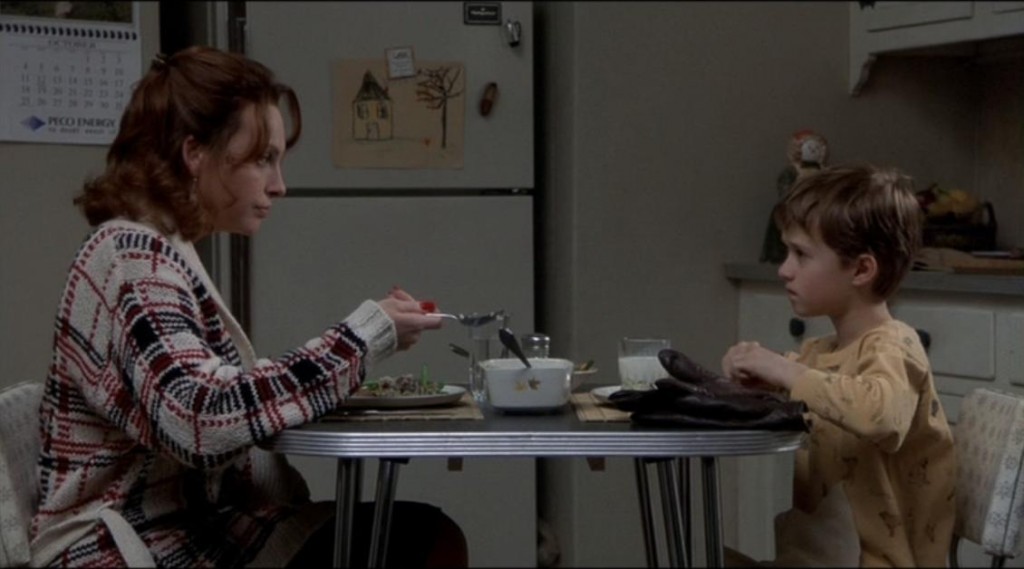
PATCHES OF WHITE HAIR WERE ALSO IMPORTANT.
Osment and Donnie Wahlberg’s character, who also saw dead people, both had some white hair on their heads. Shyamalan decided that all “spirit spotters” would have one similar physical attribute.

OSMENT’S FATHER TOLD BRUCE WILLIS TO YELL AT HIS SON TO GET HIM TO CRY.
Notice how the the camera zooms slowly towards Malcolm's face after Cole says, "I see dead people" here. The filmmakers initially feared this would be too much of a giveaway, but they decided to leave it in after none of the audiences in the test screenings picked up on it.

STRANGE THINGS HAPPENED TO TONI COLLETTE DURING FILMING.
In her Philadelphia hotel room, she always woke up in the middle of the night and always to a repeating number—1:11, 3:33, or 4:44.

MISCHA BARTON ACTUALLY THREW UP BREAKFAST CEREAL.

Future The O.C. star Mischa Barton played Kyra Collins, the little girl who was killed by her mother. The “vomit” was actually a breakfast cereal mix that she would hold in her mouth and spit up.

Barton didn’t tell her friends she was in the movie, which caused one of them to run out of a screening, horrified that her friend had just died in front of her eyes.


We see Anna framed in the broken window, connecting back to the start of the red and yellow motif, and the window symbolising the cause of her bereavement. But by breaking the window Malcolm has repeated Vincent’s action when Vincent broke into the house – Malcolm has become a destructive force in her life almost as bad as Vincent.

THE MOVIE WAS RELEASED ON SHYAMALAN’S 29TH BIRTHDAY.
The Sixth Sense was released on August 6, 1999. Because that also happened to be the director's 29th birthday, he took it as a sign that The Sixth Sense was “being guided.” His first two movies—1992's Praying With Anger and 1998's Wide Awake—grossed $350,000 combined. The Sixth Sense made more than $8 million on its opening day.

The Latin phrase Cole speaks in the church when he first meets Malcolm, "De profundis clamo ad te domine," translates to "Out of the depths, I cry to you, O Lord." These are the first few words of Psalm 130 in the Book of Psalms.

There is a motif of red and yellow flowers/leaves in the film, first seen on the autumnal leaves through the window Vincent Grey broke to enter and kill Malcolm. The motif represents something that drives Malcolm and Anna apart. We see it next in the restaurant scene where they are unable to communicate.


One of only 5 horror films to receive a BEST PICTURE
nomination.

While circling a passage in the notes, Bruce Willis does so with his right hand. Willis is actually left-handed; he learned how to write right-handed so that viewers wouldn't notice that his wedding band was no longer on his hand. Willis also draws the circle clockwise (like a left-handed person would), while most right-handed people would draw it counter-clockwise.

All of the four main characters have something in common: they strongly miss another person.
- Malcolm misses his wife.
- Anna misses his dead husband Malcolm.
- Cole misses his father.
- Cole’s mother Lynn misses her own mother.


In M. Night Shyamalan's early drafts of the script, the Bruce Willis character was a crime scene photographer, not a child psychologist

 – All these elements act in concert to form the connection. Curiously enough, while great pains were taken all through the film to hide the fact that Malcolm had no ring, in the “magic trick” scene where the penny first appears, no such attempt is made. Granted, the trick itself provides misdirection, but this omission links ring and coin in a peculiar, indirect way, as if to subtly emphasise the “magical” nature of Anna now dropping the ring.

The hardest CHALLENGE any creative mind has is comunicating and expressing what he or she really wants. If that message comes across any medium and makes us feel something, you have achieved your GOAL.
After watching The Sixth Sense, i believe M. Night Shyamalan is one of the finest directors of our time, unique twists, interesting plot lines and an incomparable style. I trully admire the craft that went in to making this monumental film. I enjoy watching it over and over again. Made us think twice about everything we see in our daily lives.


